Choose your install
Prodockit supports four installation paths. Choose the one that matches the document and level of automation you have; the paths are alternatives rather than stages to complete in sequence.
Choose an installation path
Figure 2.1 asks about each route in section order: build your first site, upgrade an existing site, build a template site, or perform the installation manually.
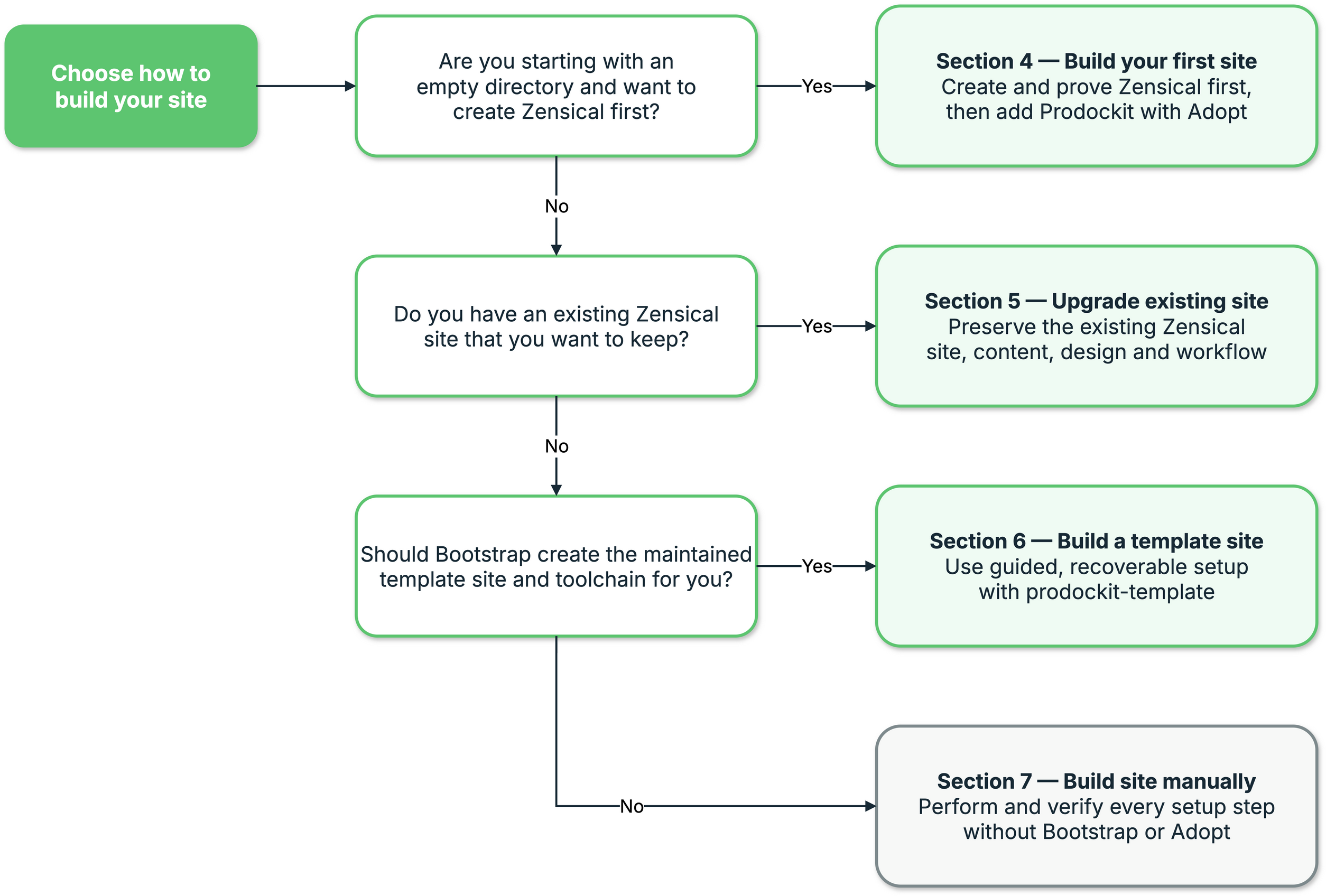
1. Choose the Prodockit installation approach
The four routes below compare their starting points and results in the same order as the following sections.
-
Build your first site
Starting point: an empty directory and no Zensical site.
Create the Python environment, install Zensical, and prove that its local preview and strict build work. Then use Adoption to add Prodockit's authoring components, PDF support, and selected renderers without using the report template.
-
Upgrade existing site
Starting point: an established Zensical site that you want to keep.
Adoption inspects the project, aligns it with Prodockit's supported toolchain, and adds the standard authoring components and styles. It keeps the site's content, design decisions, Git history, remotes, editor, and publishing workflow rather than turning it into a template project.
-
Build a template site
Starting point: a new computer, no existing site, or a project that should use the maintained report template.
Bootstrap guides and verifies the machine setup, Git host, repository, project environment, build tools, and publishing configuration. The resulting site starts from
prodockit-templateand can later receive its maintained template updates. -
Build site manually
Starting point: a project whose author wants direct control of every installation decision and command.
Prepare and verify the machine, repository, editor, Python environment, Zensical configuration, renderers, website, PDF, and source bundle yourself. This manual installation route explains all dependencies but does not use Bootstrap or Adoption to orchestrate them.
These routes are alternatives, not stages in a longer sequence. Choose only one. In particular, do not run Bootstrap merely because an adopted or manually built project later needs PDF support.
Every route starts with Prepare to install. That shared preparation establishes the supported Python and a setup environment in the directory holding your repositories. Your chosen route then explains when to enter or create the project and activate its project-specific environment.