Diagnose a project
Use prodockit diag when a project does not build as expected,
or before changing an installation in response to an error. The command is
read-only: it does not install packages, repair files, run a build, or change
the repository.
Run it from the project root:
Each line starts with PASS, WARN, or FAIL. A failure is an actionable
condition and makes the command exit non-zero. A warning records an optional
capability, an available update, or a check that could not be completed; warnings
alone leave the exit status at zero. Use --verbose to show the evidence behind
passing checks.
The shared status guide explains the normal diagnostic report.
The tables below use the stable check ID included by pdk diag --json. Find the
ID in the report, apply its remediation, then run pdk diag again. When the
configuration section fails, pdk config --check provides the individual
zensical.toml paths and complete source-project report.
The default command remains read-only. If installation.metadata reports stale
Prodockit or Zensical metadata, interactive pdk diag --apply can quarantine only
entries it can prove obsolete, then rerun distribution discovery and the
complete diagnostic report. It first prints the whole repair plan and requires
a separate Apply this repair? [y/N]: response for every supported action. Only
the exact response y or Y applies; every other response declines.
Use pdk diag --dry-run to see every repair that could be considered without
choosing an option, prompting, running a repair command, or changing anything.
Where several versions or remediations are valid, it lists all of them and
marks Leave unchanged as the default. Each option includes its warning,
affected paths, prerequisites, network requirement, recovery boundary, and the
public command or internal typed operation that could perform it.
Figure 16.1 is a short visual guide to the repair plan. Use section 28.1, Scan phases and stages for the complete explanation of its phases, stages, actions, warnings, and decisions:
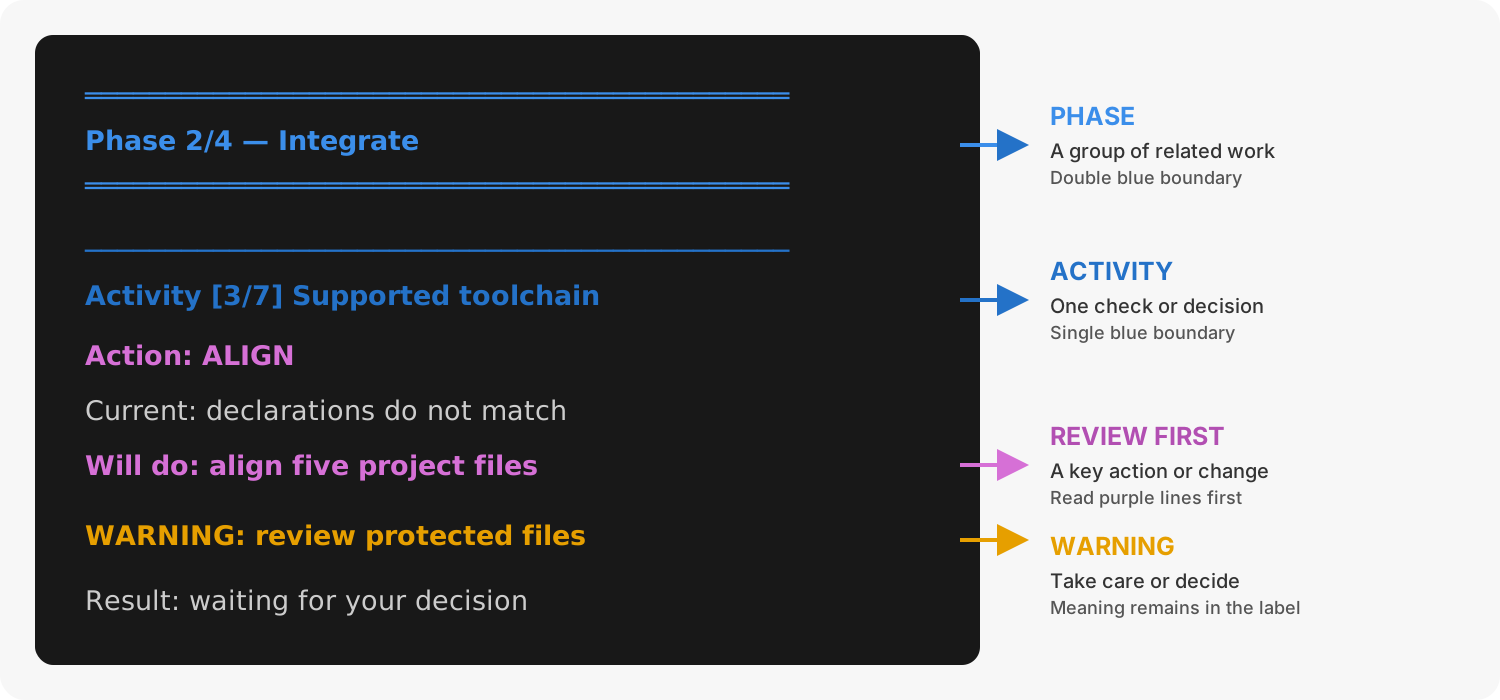
1. Reading a Diagnostics repair plan
The repair registry classifies every stable check as confirmable, online,
manual, ambiguous, prohibited, or not applicable. A source-level coverage guard
rejects a new diagnostic without a disposition. Stage 2 added the shared
transaction and rollback layer; Stage 3 adapted distribution metadata,
declared shared files, and bounded inconsistent pins. Stages 4 and 5 add locked
project-local renderer rebuilds and narrowly lossless TOML repairs. These use
the existing pins, shared-files, init-tools, and init-mathjax services.
Template metadata and updates remain manual: no diagnostic fix depends on
prodockit-template.
Each confirmed action creates
.prodockit-quarantine/diagnostics/<UTC timestamp>/manifest.json inside its
permitted boundary. The manifest records the stable repair/check/choice IDs,
the explicit confirmation, Prodockit version, original and backup paths, and
SHA-256 hashes without recording file contents, environment variables, or
credentials. Metadata retains the stricter active-virtual-environment boundary.
Each target must resolve within that boundary and must not itself be a symlink.
The virtual-environment rebuild is the sole operation that records internal
interpreter symlinks without following them. Recovery directories are added to
.gitignore before project-local content is quarantined. A failed verification
restores that action; a rollback failure stops the run and
reports both the original and quarantine locations for manual recovery.
Recover a confirmed repair
Normally no manual recovery is needed: a failed postcondition restores the current action automatically, while earlier confirmed actions remain applied. Keep the quarantine until the website and PDF have been rebuilt and reviewed.
If diagnostics reports rollback-failed, stop making changes and open the
reported manifest.json. Its entries are the recovery instructions:
- Confirm the manifest's
status, action ID, project root, and UTC timestamp identify the failed action. - For an entry whose
backupis present, verify the quarantined path's SHA-256 againstsha256. Move the currentoriginalaside if it exists, then copy the backup back to that exact project-relative original path. - For an entry whose
kindismissingandoperationiscreate, remove only the named original path that the repair created. - Rerun
pdk diag, then rebuild and inspect both website and PDF output. - Retain the manifest until the repaired project has been reviewed and committed. Never restore a backup into a different project or environment.
Distribution-metadata manifests live beneath the active virtual environment,
not the project. Recreate that environment instead of manually restoring it if
the recorded prefix no longer matches the interpreter running pdk.
--apply refuses redirected standard input and CI use before inspection or
mutation. Use pdk diag --dry-run --json there. There is deliberately no blanket
confirmation option.
For dependencies.shared-files, each missing target has a create-or-leave
decision. Each changed target offers a read-only expected/actual hash review,
replacement from the installed release, or leave unchanged. Replacement warns
before the decision and confirmation because it changes existing bytes. The
adapter passes only the selected state to the existing typed shared-file
service; it cannot touch an undeclared file.
For dependencies.pins, diagnostics only offers versions already detected in
the project's declarations. If one == build pin uniquely establishes the
reviewed version, that is the sole alignment option. If exact pins conflict,
every detected version remains a numbered option and Leave unchanged is the
default. Selection is not confirmation. The adapter rediscovers the package,
checks the inspected file fingerprint, backs up every file it will change, and
delegates one package and version to the existing typed pin service. It never
selects an online latest release.
For renderer.mermaid and renderer.mathjax, installation is offered only by
pdk diag --online --apply. Node and npm must pass, the project must use the
standard local renderer path, and package.json plus package-lock.json must
be valid, mutually consistent, and contain no author lifecycle scripts. A
missing pair can be created by the packaged init-tools scaffold; a partial,
custom, unpinned, or symlinked pair is refused. After confirmation the adapter
quarantines node_modules, runs immutable npm ci, and probes a real render.
MathJax then uses init-mathjax to regenerate the project-local website assets.
The warning notes that locked third-party install scripts can execute.
For project.configuration, automatic edits are restricted to
zensical.toml. Each unique spelling correction, obsolete index-setting move,
syntax-proven Prodockit extension, or recognized existing pdk.css/MathJax
asset is a separate default-No decision and confirmation. The adapter binds
the plan to the current file hash, changes one identified TOML construct,
preserves comments and unrelated formatting, parses the result, and confirms
that finding is gone. YAML, invalid syntax or values, missing author content,
unknown assets, duplicate destinations, and ambiguous paths remain manual.
For structured preview output, use:
Schema version 2 adds repair policy to every check and includes unselected dry-run choices as command argument arrays. It never emits a shell command containing credentials.
Environment and installation
Table 16.1 explains every environment and Python-installation result.
1. Environment and installation diagnostics
| Check ID | Failure or warning means | Author remediation |
|---|---|---|
environment.python |
Normally informational. An environment.inspection failure instead means Python's executable or prefix could not be inspected. |
Run python --version and python -c "import sys; print(sys.executable, sys.prefix)". Repair or reselect Python if either command fails, then reopen the terminal. |
environment.interpreters |
The shell's python command and the interpreter running pdk have different executable identities, prefixes, or Python minor versions. This catches a .venv that contains launchers from two Python installations before Adopt can install packages into the wrong one. |
Run pdk diag --dry-run --apply-check environment.interpreters. On macOS and Linux, the guarded repair asks which detected base Python to retain, defaults to leaving the project unchanged, archives the complete old .venv, rebuilds it from requirements.txt, and hands verification to the replacement interpreter. On Windows, deactivate the environment, move .venv aside, and resume Bootstrap because a running python.exe cannot safely replace itself. If a newly activated environment is healthy but pdk still launches an earlier global installation, run rehash in zsh or open a new shell. |
environment.virtual-env |
VIRTUAL_ENV names a different environment from the Python running Prodockit, or the project contains .venv but another environment is active. The second case commonly follows creating a project with Bootstrap and changing into its directory without leaving Bootstrap's parent setup environment. |
Deactivate the stale or setup environment, activate the project's .venv, and reopen the shell or select that interpreter in the editor. Confirm with python -c "import sys; print(sys.prefix)", then rerun diagnostics. Where the project does not contain .venv, matching pipx, Conda, system-Python, and CI installations remain valid. |
installation.commands |
pdk, prodockit, or zensical is missing, reports a different version from the distribution loaded by Python, or resolves outside the active Python environment. |
Activate the intended environment. Compare python -m pip show prodockit zensical with pdk --version, prodockit --version, and zensical --version; use which on macOS/Linux or where on Windows to find stale commands. Remove the stale installation or put the active environment's scripts directory first on PATH, then reinstall with python -m pip install --upgrade prodockit if required. |
installation.dependencies |
python -m pip check found a missing or incompatible installed dependency, or could not run. |
Read the named package constraint in the detail. Use python -m pip check to reproduce it, then install a compatible set in the active environment. Prefer the versions pinned by the project; do not blindly upgrade one package when another explicitly constrains it. |
installation.metadata |
Installed distribution metadata is invalid or the same normalized package name appears in more than one location. This is a warning because unrelated duplicate metadata need not prevent a build. | For duplicate Prodockit or Zensical metadata in an active virtual environment, run pdk diag --apply. It keeps the single entry matching the loaded package, moves known older entries to .prodockit-quarantine, and refuses ambiguous cases. For another package, run python -m pip show PACKAGE and investigate manually; the fixer deliberately leaves it unchanged. |
environment.inspection / installation.inspection |
An operating-system or metadata error prevented that whole diagnostic area from being read. Other sections still run. | Use the error detail to correct permissions or the damaged installation. Rerun with --verbose; if it persists, attach the JSON report and the output of python -m pip check to a support request. |
Project configuration and inputs
project.configuration loads the same project model used by Prodockit's PDF
pipeline and reuses the complete pdk config --check integrity inspection. It
does not replace Zensical's own strict build.
Table 16.2 maps its possible problems to an author action.
2. Project configuration and input diagnostics
Problem reported for project.configuration |
Author remediation |
|---|---|
| The configuration cannot be loaded | Confirm the file exists and is valid TOML or YAML. Pass a non-standard location with pdk diag -f PATH. Correct the first parser error before investigating later settings. |
| An obsolete Prodockit setting | pdk diag --apply can move the two legacy index settings when the destination is unambiguous. Otherwise replace it with the setting named by pdk config --check; do not keep both old and new names. |
| An unknown or misspelled Prodockit setting or extension | pdk diag --apply offers a rename only when one supported spelling is uniquely identified. Otherwise use the report to decide manually. If the setting belongs to another Zensical extension, keep it in that extension's own table rather than a prodockit.* table. |
| A setting has the wrong type or an invalid value | Change it to the boolean, string, list, or non-empty value described by pdk config --check. |
| A stylesheet, JavaScript file, navigation page, Markdown image, or configured CSL file is missing | Restore the referenced file or correct its path relative to zensical.toml. Generated MathJax assets should be restored with pdk init-mathjax; do not commit third-party generated files when the project intentionally ignores them. |
A local .css or .js asset exists but is not configured |
pdk diag --apply can add only a recognized existing Prodockit stylesheet or MathJax asset. For every other file, choose whether to configure or remove it. |
| A configured Mermaid, MathJax, Pandoc, browser, or other renderer is unavailable | Install the project's pinned toolchain with pdk init-tools, or correct the configured executable/script path. The rendering-tool section identifies the missing component separately. |
| Back-of-book index generation is enabled but its optional PyMuPDF package is missing or cannot import | Install the project with the index extra: python -m pip install "prodockit[index]". If it is already installed, reinstall it in the active environment so its native extension matches the Python and operating-system architecture. |
| Prodockit syntax is present while its extension is disabled | pdk diag --apply can enable the uniquely identified extension in TOML. Otherwise enable it manually or remove syntax the project no longer uses. |
After correcting the source problem, run both checks:
The first gives the complete configuration report; the second confirms the configuration alongside the environment and external tools.
Dependencies and managed files
Table 16.3 covers declarations recorded in the project, rather than packages currently imported by Python.
3. Dependency and managed-file diagnostics
| Check ID | Failure or warning means | Author remediation |
|---|---|---|
dependencies.pins |
A failure means two or more discovered declarations name different versions. A warning means the declarations do not match the complete software combination supported by the installed Prodockit release. With --online, it can also mean a newer release exists or the package index could not be queried. |
For a supported-combination warning, run pdk pins, review the inventory, and accept each tested default. This is deliberately not a pdk diag --apply: choosing and applying versions remains visible in the dedicated pins workflow. For disagreement, run pdk pins --check --offline, review every declaration, then use pdk pins --set PACKAGE=VERSION to move them together. For an available update, rebuild and review output before adopting it. For a lookup warning, retry later or use the deterministic offline form. |
dependencies.shared-files |
A file declared in .prodockit-shared-files.toml is missing or differs from the installed Prodockit release, or the shared-file manifest is invalid. |
Run pdk shared-files --check --verbose. Review local changes first; use pdk shared-files --apply only when the installed release is the intended source. Move project-specific CSS into the documented project-owned stylesheet before replacing a managed file. |
dependencies.inspection |
Files containing version pins or shared-file metadata could not be read. | Correct the path, encoding, manifest syntax, or file permissions named in the detail, then run the narrower pdk pins --check --offline and pdk shared-files --check commands. |
Rendering toolchain
A renderer is a failure only when the current configuration requires it. Missing unused tools are warnings, so a website-only project does not have to install the PDF toolchain merely to make diagnostics pass. Table 16.4 gives the repair for each component.
4. Rendering-toolchain diagnostics
| Check ID | Failure or warning means | Author remediation |
|---|---|---|
renderer.pandoc |
Pandoc is not on PATH, does not run, or reports no version. |
Install the version pinned by the project and reopen the terminal. Confirm with pandoc --version. Bootstrap-managed projects can use pdk bootstrap --apply. |
renderer.weasyprint |
A fresh Python process could not import WeasyPrint. On Windows the detail distinguishes a missing MSYS2 installation, the architecture-matched libpango-1.0-0.dll, failed pacman package integrity, a missing persistent WEASYPRINT_DLL_DIRECTORIES, and a value not yet active in the current process. The architecture is read from python.exe, not the host CPU: an ARM64 computer running x64 Python requires UCRT64 x64 libraries. |
On Windows, review pdk diag --dry-run --apply-check renderer.weasyprint. The interactive repair is default-No, warns before changing the MSYS2 package or user environment, conditionally reinstalls the architecture-matched Pango package, refreshes the current process, and verifies a fresh import without a restart. On other platforms, run python -c "import weasyprint; print(weasyprint.__version__)", then install the native libraries described in the installation guide. pdk adopt remains project-scoped and does not mutate system libraries. |
renderer.node |
Node is missing or cannot report its version. | Install the project's supported Node version, reopen the terminal, and confirm with node --version. |
renderer.npm |
npm is missing or cannot report its version, even if Node itself exists. | Repair or reinstall the Node distribution so npm --version works. Avoid mixing Node and npm from different installations on PATH. |
renderer.mermaid |
Authored Markdown uses a Mermaid fence but neither the project-local mmdc nor a usable command on PATH exists, or a minimal SVG render fails. The render probe also exercises Puppeteer and its browser. |
With standard locked project tooling, use pdk diag --online --apply --apply-check renderer.mermaid. Custom paths and manifests require manual review. If the detail names a browser failure, install Chrome/Chromium or correct PUPPETEER_EXECUTABLE_PATH. |
renderer.browser |
An explicit Chrome or Chromium executable was not found, or its configured path does not name a file. Diagnostics deliberately does not launch a graphical browser to query its version; the Mermaid render probe is the functional check. A successful Mermaid render proves its bundled browser and passes this check without requiring a separate browser installation. | If the Mermaid render probe succeeds, no action is required. Otherwise install Chrome/Chromium or set PUPPETEER_EXECUTABLE_PATH to its executable, then rerun diagnostics. |
renderer.mathjax |
Authored Markdown uses mathematical notation but tools/mathjax/tex2svg.js is missing or cannot convert a minimal expression using the installed mathjax-full inputs. |
With standard locked project tooling, use pdk diag --online --apply --apply-check renderer.mathjax; it also regenerates website assets. Custom paths and manifests require manual review. |
renderer.mermaid-security |
Offline diagnostics explicitly skip the advisory lookup. With --online, a warning means npm found a moderate-or-higher production dependency advisory, npm is missing, or the advisory service could not be queried. This check is separate from renderer.mermaid: a renderer can execute correctly while depending on vulnerable packages. |
Run npm audit --omit=dev in tools/mermaid, review the advisory and update the committed manifest and lockfile together. Rerun npm ci, confirm pdk diag still renders Mermaid, then rerun pdk diag --online. For an unavailable lookup, retry online later; the default offline diagnostics make no network request. |
renderer.inspection |
An operating-system error prevented the rendering tools from being inspected. | Correct the path or permissions named in the detail. Run each shown executable with --version, then rerun pdk diag --verbose. |
renderer.security-inspection |
An operating-system, decoding, or subprocess error prevented the Mermaid advisory check from completing. Other diagnostic sections still run. | Confirm npm audit --omit=dev --json works in tools/mermaid, correct the reported environment or permission problem, then rerun pdk diag --online --verbose. |
Repository and template maintenance
Repository checks are read-only. The default form examines local Git and
template metadata only; --online adds the remote template comparison. Public
GitHub template checks use HTTPS, and other Git probes disable authentication
and host-key prompts rather than taking input intended for Diagnostics.
Table 16.5 explains each repository result.
5. Repository and template diagnostics
| Check ID | Failure or warning means | Author remediation |
|---|---|---|
repository.git |
Git is unavailable, the project is not inside a repository, the repository cannot be inspected, or it has no configured remotes. Most of these are warnings because a local document can still render. | Run diagnostics from the project root. Install Git if the project uses repository macros or publishing automation. Use git remote -v and the repository host's clone instructions to restore the intended remote; do not invent a remote for an intentionally local project. |
repository.template-metadata |
.prodockit-template.toml is invalid, .prodockit-template is empty or unreadable, or ownership metadata cannot be parsed. A valid stamp reports both the exact comparison revision and the last template release successfully applied; a legacy stamp may not yet have the release. Absence of both files is valid for a project that was not created from the template. |
Restore the files from version control or repair the exact manifest/stamp error. Do not guess a template commit or release. For a legacy template-derived project whose applied release is not recorded, run pdk template-sync to preview the migration and apply it through the normal reviewed workflow. |
repository.template-update |
With --online, a warning means the recorded template revision differs from the template host's current HEAD, or the comparison could not be completed. It is never an automatic failure. |
If an update exists, run pdk template-sync to preview it, then follow its reviewed --apply workflow. If the lookup failed, check network/SSH access and retry; the offline diagnostic remains deterministic and valid. |
maintenance.adopt-readiness |
Diagnostics found the same local supported-toolchain, standard-component, or saved component-choice work that pdk adopt and the prerequisite phase of template-sync would report. Standard-component details name only the missing extensions or website inputs. An existing bibliography-backed or inline citation implementation satisfies the citation capability without enabling the alternative. A warning means bounded integration remains; a failure means Adopt found a blocker. This check is local and independent of prodockit-template. |
Run pdk adopt --dry-run to review the matching activities, then pdk adopt --apply. A missing .prodockit-components.toml appears as its own manifest-only activity and defaults both optional renderers off; use pdk adopt --configure first when the project needs Mermaid or maths. Rerun pdk diag; it should pass this check before template-sync introduces unrelated template changes. An offline diagnostic cannot report a remote template update; use pdk diag --online or pdk template-sync for that separate comparison. |
repository.inspection |
Git or template files raised an operating-system error after the project was found. | Correct the path or permissions named in the detail. Confirm git status and git remote -v work from the project root, then rerun diagnostics. |
Attach a report to a support request
Generate structured evidence without copying terminal colour or screenshots:
The report shortens project and home-directory paths and removes credentials
embedded in HTTPS remote URLs. Review it before attaching it, as you would any
diagnostic file. Include the command you ran, the build error, operating system,
and whether the failure is local, in CI, or both. Use --online only when the
support question concerns published versions or template drift.
Do not attach generated documentation, private source files, credentials, or repository secrets unless the support channel explicitly requires them and is approved to receive them.