pdk adopt
pdk adopt adds selected Prodockit components and the supported toolchain to
an existing Zensical document. It is project-scoped: it does not configure Git,
SSH, an editor, a remote, or Pages, and it never commits or pushes.
Use the Adopt task guide for the preparation and review workflow.
Synopsis
Use the assessment form first, then choose configuration, preview, or apply.
With no mode option, Adopt assesses the project and reports outstanding activities.
Working directory
Run Adopt from the root of the existing project, where its Zensical
configuration and .venv are located. Adopt has no project-path option because
its safety checks and changes are intentionally scoped to the current project.
If the current directory holds one or more project repositories, Adopt refuses to start and names them:
Error: C:\path\to\workspace holds projects rather than being one (report-student).
Open a terminal in the project you want adopted, or cd into it.
In another wrong directory, the first assessment reports Existing
documentation project — no Zensical configuration is here and tells you to
run the command from the directory containing the configuration. Stop there
and change directory; do not create a configuration merely to satisfy Adopt.
Options
Table 38.1 lists the available project-integration controls.
1. Adopt options
| Option | Behaviour |
|---|---|
--configure |
Choose optional components and save them in .prodockit-components.toml. |
-n, --dry-run |
Show activities, files, and changes without writing or installing. |
-a, --apply |
Apply required activities, asking before each change. |
--offline |
Use only the configured wheelhouse and validated native cache. |
--mermaid, --no-mermaid |
Select or omit project-local Mermaid rendering. |
--maths, --no-maths |
Select or omit MathJax rendering. |
-v, --verbose |
Show the files and commands behind each activity summary. |
-h, --help |
Show installed help and exit. |
Output
Figure 38.1 shows the output structure. Use section 28.1, Scan phases and activities for the complete explanation of the phase, activity, action, warning, and decision language:
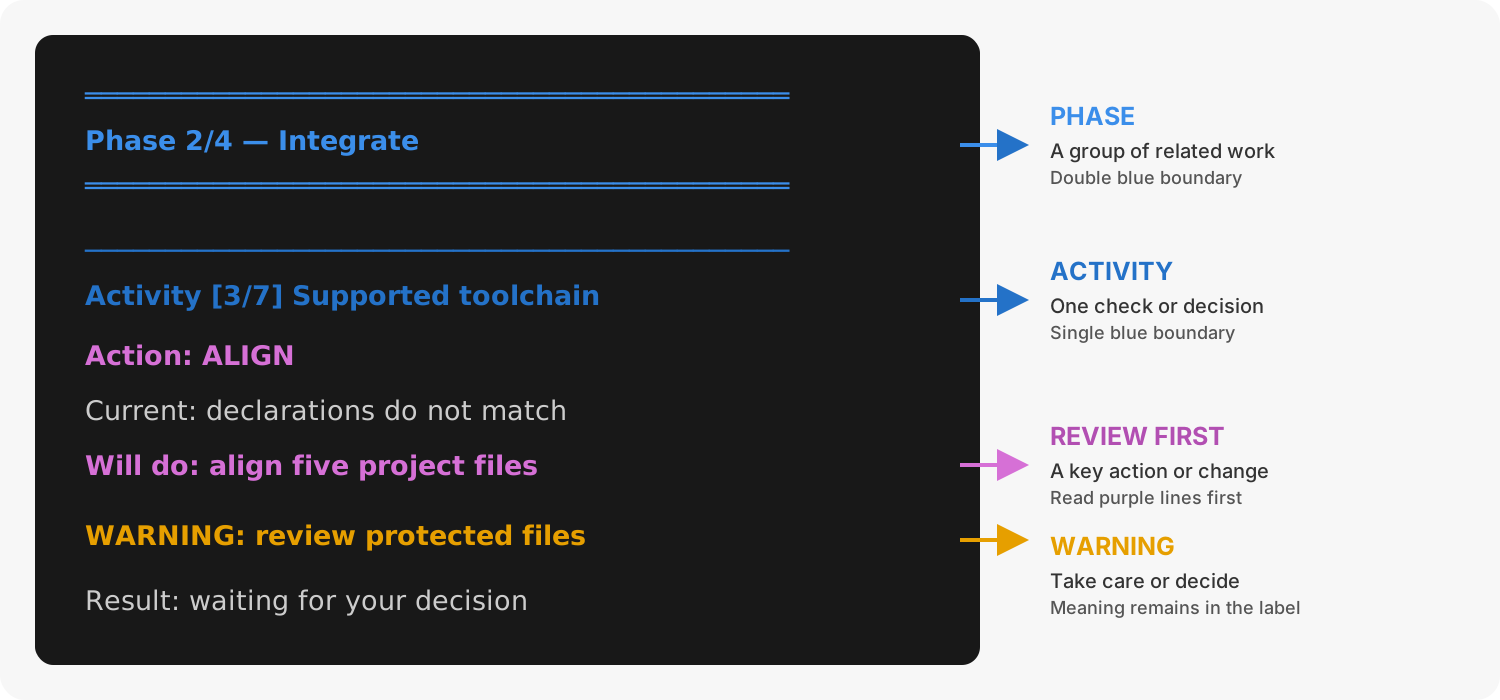
1. Adopt output structure
Effects and ownership
Adopt can install, upgrade, or downgrade software in the active project
environment to the combination supported by the installed Prodockit release.
It can also align version declarations, enable the standard extensions, install
the managed pdk.css, pdk-pdf.css, and pdk.js files; create missing
user-managed extra.css, print.css, and extra.js files without replacing
their contents; record the stylesheet and JavaScript cascades; save component
choices; provision the supported
configured citation style when it is missing, and initialise selected
project-local renderers.
For selected renderers, a separate Node.js and npm activity uses Bootstrap's
runtime installation policy on macOS, Ubuntu and Windows. It reuses an adequate
runtime, installs a missing one, or upgrades/repairs an unsupported one. Node
and npm follow Bootstrap's minimum supported versions; the renderer packages
themselves use the installed release's exact lockfile.
The system package manager may request administrator approval. Adopt refreshes
its own PATH after installation and verifies both commands before continuing.
It cannot rewrite the parent terminal's environment: if the verification still
fails, an uppercase restart message includes the platform's activation command.
On Windows, a missing WinGet is registered or installed using Microsoft's
Microsoft.WinGet.Client repair workflow in current-user scope, before the
runtime installer runs. It does not change PowerShell execution policy.
Homebrew is the agreed manual prerequisite on macOS: install it from
the Homebrew website, complete its shell setup instructions,
then reopen the terminal, activate the project's environment and rerun Adopt.
Adopt installs the required runtime packages once Homebrew is available.
An offline run cannot
provision a missing package manager. Git, SSH and editors are not part of this
runtime activity. Windows package-manager provisioning still requires native
acceptance testing before issue 782 can be considered complete.
The native PDF activity installs or repairs Pango and the required PDF fonts. It reuses Bootstrap's Homebrew, Ubuntu and architecture-aware Windows MSYS2 recipes without changing Adopt's separately pinned Pandoc installation. On macOS it preserves the Homebrew library path in the active virtual environment's activation script. On Windows it refreshes the current process from the persistent library/PATH settings. Verification generates a small PDF and checks that Inter and JetBrains Mono are available rather than accepting fallback fonts. A failed verification leaves the activity incomplete.
Existing citation styles are preserved; an unknown custom filename receives manual guidance rather than a guessed download.
.prodockit-components.toml belongs to the project. When it is missing, Adopt
detects existing project-local renderer installations, including partial installs.
Otherwise Mermaid and maths default off: Zensical's capable starter configuration
alone is not an author choice. Run pdk adopt --configure or use
explicit flags to select them. Template projects ship the component file with
both enabled.
Result
Adopt records its template-setting review separately from the checks that verify the project's current configuration and installed software.
Selected renderer versions and backups
Normal output explains why a change is needed and what Adopt will change.
Healthy checks are kept short. Run pdk adopt --dry-run --verbose to include
the file lists, installer commands and technical checks. Version-change details,
warnings and recovery instructions remain visible without --verbose.
After setup, run pdk diag and the displayed build command to check your
project. Setup being complete does not mean that the website has been built
or published.
Adopt stops if the project's managed declarations require a newer Prodockit than the command currently running. Activate the project's environment and install that release (or a compatible newer release) before trying again. This prevents an older Adopt from replacing files supplied by a newer template sync. Once Prodockit is compatible, Adopt can still upgrade or downgrade its dependencies to the supported combination.
Mermaid needs a browser; MathJax does not. On Ubuntu, Adopt reuses a detected browser or installs the system Chromium package, which selects the machine's architecture. It disables npm's automatic Puppeteer browser download so ARM64 hosts do not receive an incompatible Chrome build. On macOS and Windows it reuses an available browser or invokes the already installed, locked Puppeteer CLI to download its matching browser. The browser download has bounded retries; timeouts stop with recovery guidance rather than starting another installer.
During installation, Adopt reports elapsed progress. After a completed failed
renderer installation it removes the incomplete node_modules directory before
retrying, or before returning the final error. Your configuration, lockfiles and
source files are retained. Partial Pandoc downloads are also discarded rather
than reused. System packages are recovered through their package manager, not
by deleting system directories.
If an installer times out or you interrupt it, Adopt attempts to stop its process tree. It does not automatically retry or delete files that a detached installer could still be using; check the recovery message before running Adopt again.
Offline use requires an existing system browser or, on macOS/Windows, a usable
Puppeteer cache. A missing explicitly configured PUPPETEER_EXECUTABLE_PATH is
reported rather than silently replaced. Browser-file detection is only a
prerequisite: the final Mermaid check must actually generate an SVG diagram.
For selected Mermaid and maths components, Adopt aligns tools/mermaid and
tools/mathjax with the renderer files shipped in the installed Prodockit
release. It installs from that release's lockfile, allowing both upgrades and
downgrades. A renderer that still works but has the wrong version is not
reported as aligned. Unselected renderers are left alone.
The activity lists the tool files it may change. Before replacing existing
manifests, lockfiles or the MathJax conversion script, Adopt saves their original
contents under .prodockit-adopt-backups/renderers. This includes customised
copies: selecting Adopt's supported renderer replaces those tool files, not
just their version numbers. Your documentation and user-managed website assets
are not replaced by this operation. Backups are excluded from Git; retain them
until you have checked the result. Restoring a custom tool file will make the
next assessment request alignment again.
If writing a backup fails, no renderer files in that component are replaced. If a later file write or npm install fails, rerun Adopt: the backups remain and it will check the actual files and renderer health again. Existing Windows line endings alone do not cause a replacement.
Template settings and the review ledger
For a zensical.toml project, Adopt also checks the template for settings it has
not reviewed before. It reads the public template over HTTPS; Git, SSH and a
GitHub account are not required. Downloads use bounded requests: temporary
network failures are retried twice, with visible warnings and waits of two and
five seconds. Permanent HTTP errors and invalid
responses are not retried. A compatible cached snapshot can be used if the
download still fails. The configuration and version declaration come
from the same immutable commit. A template requiring a newer Prodockit release
is not used automatically. Known defaults still come from the installed
Prodockit release, not from the template's values.
- Existing project values are preserved.
- Missing settings recognised by Adopt use its existing configuration rules.
- New, unrecognised settings are added as commented examples, never enabled just because they appeared in the template. Merge a reviewed example into its named table; do not create a duplicate table or key.
- Site identity, navigation, theme/branding, repository details, template-only
plugin configuration, custom template icons and PDF copyright are excluded.
template.cssis not introduced. Existing user-owned settings are not removed.
Adopt records each full setting path and its outcome in
.prodockit-adopt.toml: added, commented, excluded or already present.
This is separate from .prodockit-components.toml, which saves the Mermaid and
maths choices. Commit the review ledger if the team should share this history.
Later runs review only unseen template keys; changes to the value of an already
reviewed template key do not overwrite the project or its examples.
To reset the template review, delete only .prodockit-adopt.toml, then run
pdk adopt --dry-run and pdk adopt --apply. Existing active settings and
generated examples are preserved, and generated examples are not duplicated.
Deleting the ledger does not uninstall software or clear component choices.
The ledger controls template-setting import, not readiness checks. Required known configuration, software versions and renderer health are still checked; an installation record is never accepted as proof that a tool currently works. Configuration and ledger edits use TOML Kit to preserve comments and layout, with a separate TOML parse validation before atomic file replacement. The ledger is saved after the configuration, so an interrupted write can be retried safely.
Offline or locally supplied template
A successful settings application caches the downloaded snapshot for the
installed Prodockit version. --offline uses that cache without contacting
GitHub. A failed online lookup can also use this cache; the command identifies
the cached source. If neither a usable online snapshot nor cache is available,
Adopt stops with recovery guidance before starting installation activities.
You can supply a compatible template configuration directly, including offline:
pdk adopt --dry-run --template-config /path/to/template/zensical.toml
pdk adopt --apply --template-config /path/to/template/zensical.toml
Choose a configuration compatible with your installed release when using this explicit override. A local override is not saved into the global download cache. Assessment/dry-run does not write the project, ledger or snapshot cache. The template ledger currently applies to TOML projects; existing YAML adoption continues to use its standard configuration handlers.
Completion checks
Assessment and dry-run modes report the number of activities needing work. Apply mode reassesses the resulting configuration and names the strict local build command. It reports an incomplete result if required work remains; configuration verification does not replace a successful build. A blocking project or environment check stops the integration.
Adopt is independent of Bootstrap. If a virtual environment is active and the
project has its own .venv, they must match; otherwise Adopt stops before
configuration or package changes. An intentionally named environment is accepted
when the project has no .venv. With no active virtual environment, Adopt warns
that package changes will affect the running Python installation. Create and
activate an environment first unless that is intentional.
Related commands
Use these commands before or after Adopt for their separate responsibilities:
pdk diagreports when Adopt integration remains and verifies the result.pdk pinsmakes an explicit version-selection decision across declarations.pdk template-syncinvokes Adopt as a prerequisite but separately owns template files and review branches.